Migration Testing for Spirits Bottles: What Importers Should Ask For
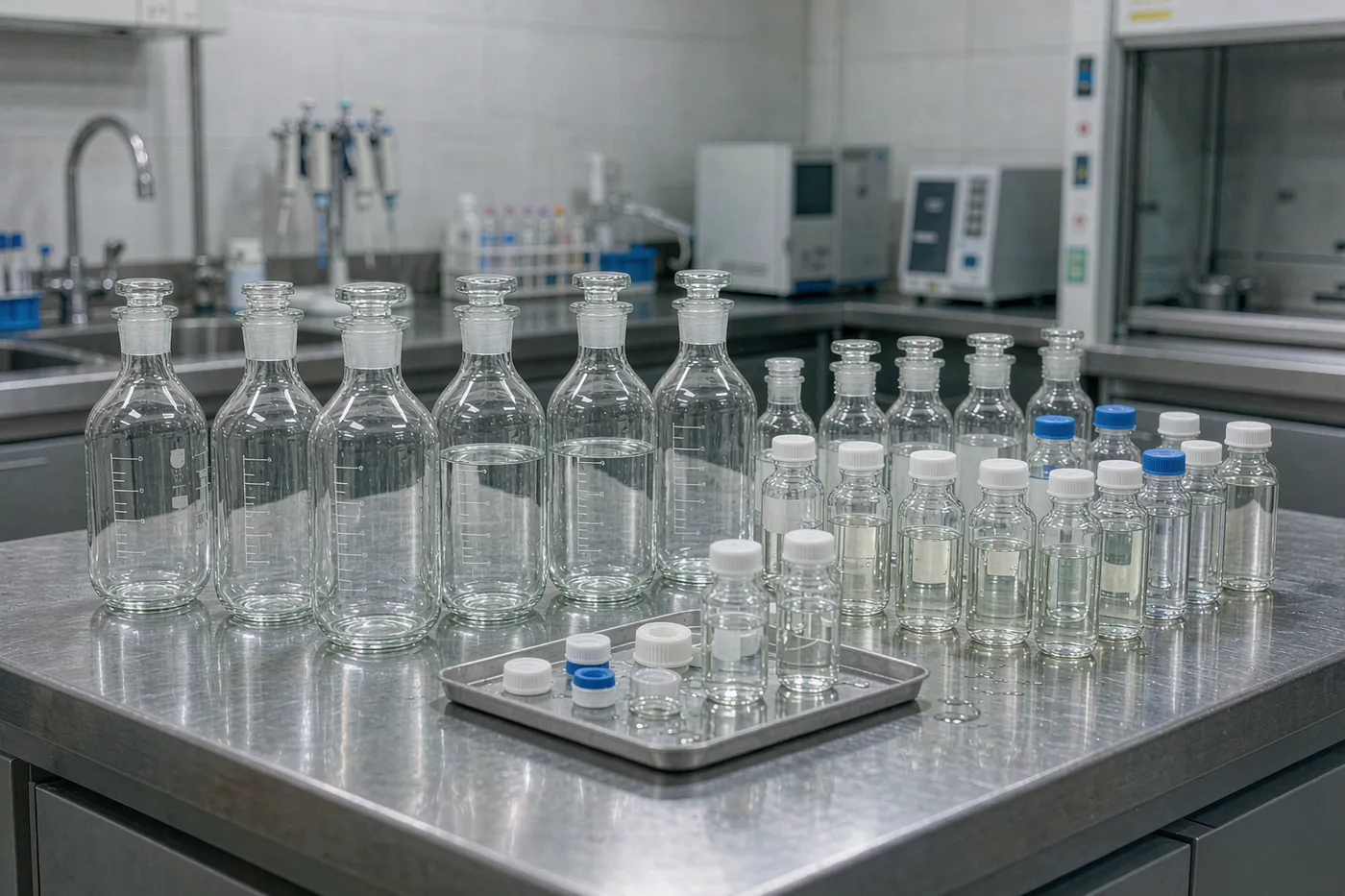
Migration testing measures what moves out of a packaging material and into the product. For spirits the wall of the bottle is rarely the issue; the decoration, coating and closure liner are.
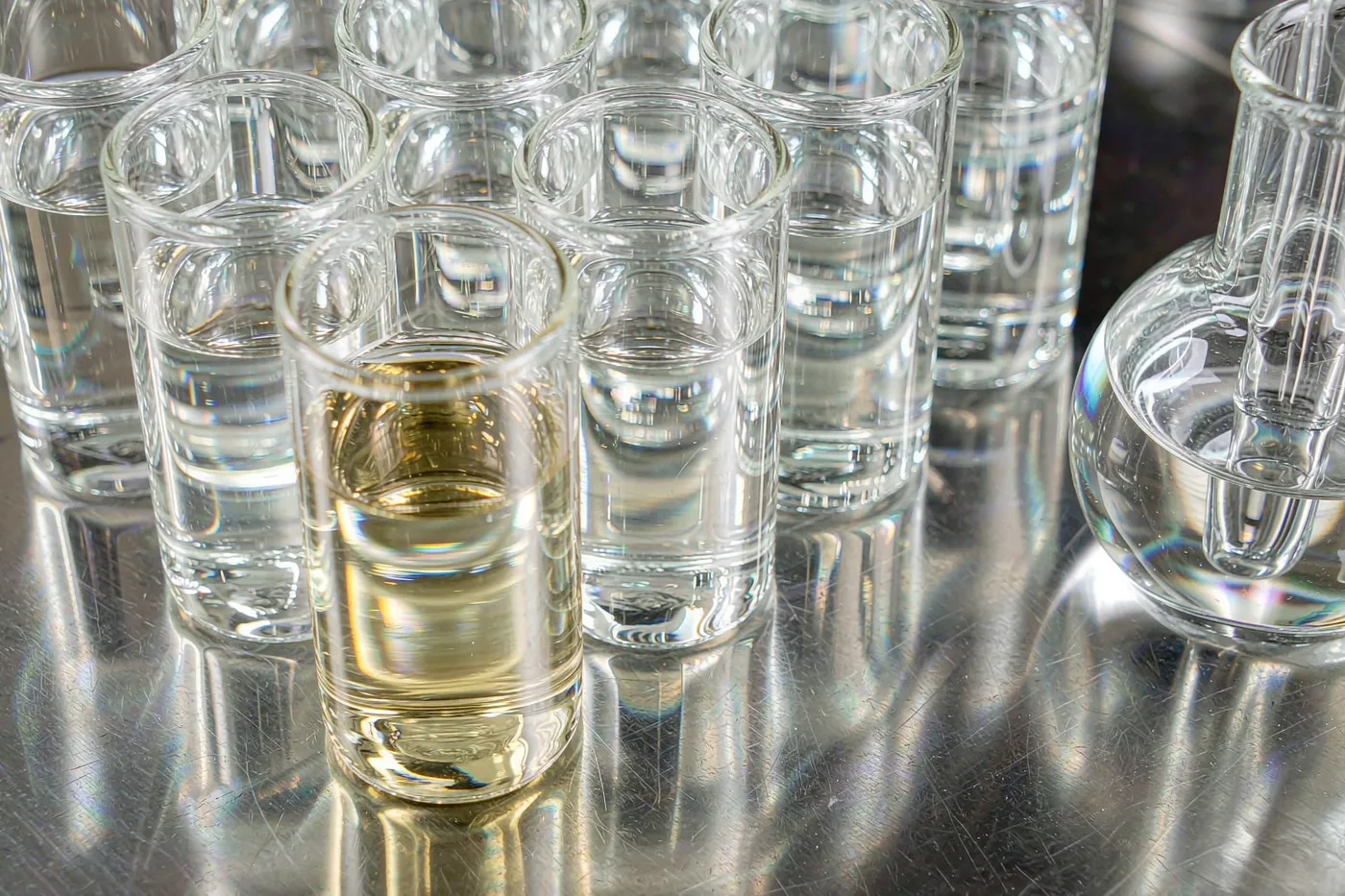
Why it matters for spirits specifically
Spirits are a demanding simulant: 40 percent ABV and above, often with citrus oils, botanicals or sugar. Ethanol extracts far more aggressively than water, which is why high-ethanol simulants are used for high-proof products.
Overall versus specific migration
- Overall migration — the total mass of substances that transfer into the simulant. Under the EU plastics regulation the limit is 10 mg per square decimetre, also expressed as 60 mg per kilogram.
- Specific migration — the limit for one named substance, derived from toxicological evaluation.
Both apply to plastic layers and coatings rather than to the glass wall.
Simulants you will see quoted
- 10 percent ethanol — aqueous and low-alcohol foods.
- 3 percent acetic acid — acidic foods below about pH 4.5.
- 20 percent ethanol — alcoholic foods.
- 50 percent ethanol — high-alcohol products and fatty foods in some regimes.
- Vegetable oil or Tenax — fatty foods.
For spirits, the high-ethanol simulant is the relevant one.
Contact conditions
Conditions are chosen to envelope the most aggressive intended use:
- 40 degrees C for 10 days — long-term ambient storage, the usual default for shelf-stable spirits.
- 70 degrees C for 2 hours — short-term hot-fill or warm exposure.
- Reflux or higher temperatures — only where the process genuinely demands it.
NIAS and the declaration of compliance
- NIAS are non-intentionally added substances: impurities, reaction by-products and degradation products.
- A serious migration study identifies them and evaluates each against toxicological thresholds or compound-specific data.
- The declaration of compliance is the document that ties the material, the intended food categories, the contact conditions and the test results together.
What to request from a glass supplier
- A declaration of compliance for the glass container.
- A separate declaration or test report for each coating, ink, enamel and liner.
- Heavy metal release testing on decorated surfaces, with method and laboratory accreditation named.
- Migration testing at a contact condition that matches your real storage profile.
- Batch traceability linking the reports to the goods shipped.
How to read a report
- Check the laboratory accreditation, normally ISO 17025.
- Check the simulant and contact conditions match your use case.
- Check the sample description matches the bottle and decoration you are buying.
- Check the date, and ask whether the formulation has changed since.
Reading a migration test report
A usable report has four elements, and the absence of any one of them makes the document close to worthless:
- The simulant and the contact conditions — what liquid, what temperature, how long.
- The test method — overall migration by gravimetric or a recognised alternative; specific migration by a validated method for the substance in question.
- The analytical result with units — not merely "pass".
- The applied limit and its source — the specific migration limit for that substance, and the regulation it comes from.
Overall migration in the EU plastics measure carries a limit of 10 mg per square decimetre of contact surface, or 60 mg per kilogram of food where the surface area is not known. Specific limits are set per substance and are frequently far lower.
Which parts of the bottle to test
Prioritise by exposure path, not by surface area:
- The closure liner — in direct contact with liquid and the most common source of a specific migration result.
- The rim and finish area — contacts the mouth and the liquid. Where rim-area release testing applies, this is the surface.
- Decorated external surfaces — relevant where decoration can reach the liquid or the mouth, and required for heavy metal screening in most programmes.
- The internal coating, if any — where a bottle is internally coated, this becomes a direct-contact layer.
Uncoated glass itself is not the concern. Every material added to it is.
Test timing and batching
Migration testing is not instant, and results are per configuration. Plan for:
- One configuration per test — decoration, coating and liner each need their own assessment. Changing any one of them invalidates the previous result.
- Testing against production samples — laboratory samples off the actual steel, not a lookalike.
- Repeat testing on recipe change — a new coating supplier or a decoration colour change is a new test.
The common failure is testing once early and then changing the decoration late without re-testing. That is where most compliance surprises come from.
Retesting triggers
A migration result is valid for a configuration, not for a product line. Re-test when any of these changes:
- Decoration or coating formulation, colour or supplier.
- Closure liner material or supplier.
- Contact conditions — a higher ABV, a new filler or a longer declared shelf life.
- Destination market, where the applicable limits or simulants differ.
Document the configuration each report relates to, including drawing revision. Most compliance gaps come from a report that no longer matches the product.
Scoping a test programme
- Start from the formulation, not from a generic test list — ABV, sugar, acid and botanical load drive the choice.
- Test the finished decorated article, not the container alone.
- Separate contact layers — liner, coating and each decoration colour may need their own assessment.
- Confirm the destination's limits and simulants before commissioning, because they are not universal.
A programme scoped this way produces reports that are usable in more than one market.
Units, limits and what "pass" means
Migration results are only meaningful with units attached:
- Overall migration is expressed per contact surface area, or per mass of food where the area is not known.
- Specific migration is expressed per mass of food or simulant for a named substance.
- Contact conditions — temperature and duration — have to be stated alongside, because the same material gives different results under different conditions.
A report that says only "pass" without units, substance, simulant and conditions cannot be checked, and therefore cannot be relied on.
Key takeaways
- In spirits the glass wall is rarely the issue - decoration, coating and liner are.
- High-ethanol simulants are the relevant ones for spirits, because ethanol extracts more aggressively than water.
- Overall and specific migration apply to plastic layers and coatings rather than to uncoated glass.
- Migration results are per configuration; changing decoration, colour or supplier invalidates them.
- A report without units, substance, simulant and contact conditions cannot be checked.
- Test on production samples after decoration, not on a lookalike.
Frequently Asked Questions
Do glass bottles need migration testing?
Uncoated glass is inert, so migration from the wall is not a practical concern. Testing becomes necessary when the bottle carries a coating, ink, enamel or a closure liner, because those are separate food-contact materials.
What is overall migration?
Overall migration measures the total mass of substances that move from the material into a food simulant. In the EU plastics regime the limit is 10 mg per square decimetre, also expressed as 60 mg per kilogram.
Which simulant is used for spirits?
High-alcohol products are tested against a high ethanol simulant, typically 50 percent ethanol, because ethanol drives extraction far more aggressively than water or dilute acetic acid. Confirm the simulant with the destination market's rules, since not every regime prescribes the same one for the same product.
What are NIAS?
NIAS are non-intentionally added substances: impurities, reaction by-products and degradation products that appear in the material without being an intended ingredient. A thorough migration study identifies them and evaluates each against toxicological thresholds or compound-specific data, rather than testing only the substances on a positive list.
How long does testing take?
It depends on the contact conditions. Long-term ambient storage is commonly simulated at 40 degrees C for 10 days, so plan the calendar around that, plus sample preparation, laboratory queue time and reporting. Treat it as a programme task with a buffer, not a checkbox at the end.
Can I reuse an old test report?
Only if the formulation, decoration, coating, liner and production conditions are unchanged. If any of those moved, the report describes a different article and cannot be relied on. Most compliance surprises come from a report that no longer matches what is being shipped.
Related
- Food-Contact Compliance for Spirits Glass Bottles: FDA, EU and LFGB
- California Prop 65 and Heavy Metals in Glass Bottles and Decoration
- Closure Liners and Seal Integrity: Stopping Leaks and Evaporation
Written by Eric Jiang, Glass Packaging Engineer, 12 years.