MOQ, Lead Time and Sampling Guide for Custom Glass Bottles
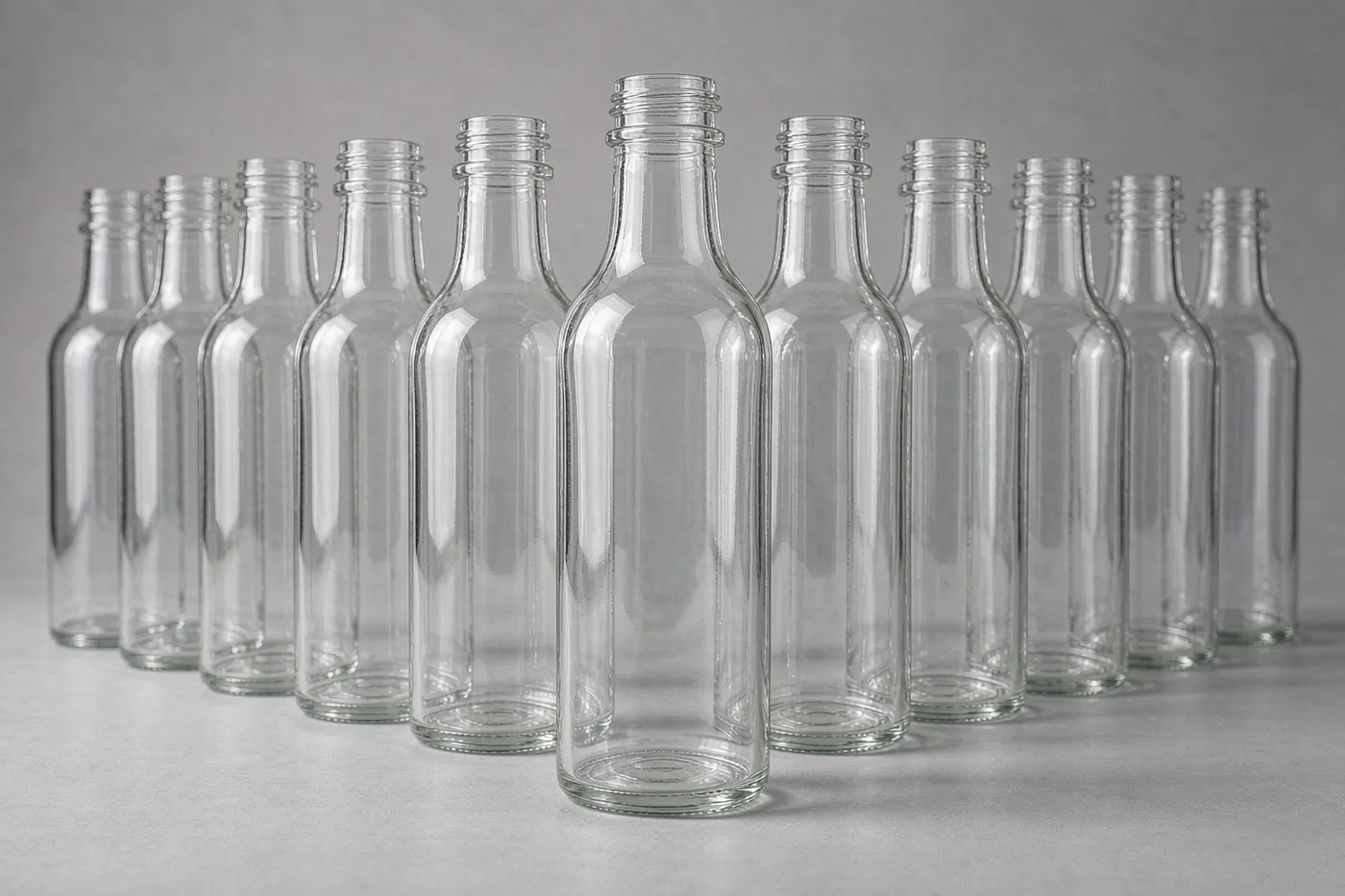
Glass minimums are high for a mechanical reason: a furnace runs continuously, and changing colour or shape costs production time. Understanding that explains where the negotiation room is, and where there is none.
Why MOQ exists
- Furnaces run continuously for years; stopping is extremely costly.
- Each shape and colour change costs changeover time.
- Mould set-up, warm-up and stabilisation add hours before good bottles appear.
- Plants therefore sell run length, not individual bottles.
Typical ranges
Treat these as planning shapes, and confirm against your own project:
- Stock mould — commonly around 1,000 to 3,000 pieces.
- Custom tooling — higher, because the plant must amortise the campaign.
- Decoration — often adds a per-colour or per-pass minimum.
- Custom colour — usually carries the highest threshold of all.
How to reduce the effective minimum
- Use a stock mould rather than tooling new steel.
- Choose a standard colour the plant already runs.
- Consolidate several SKUs into one campaign.
- Accept a higher unit price in exchange for a shorter run.
- Ship less-than-container loads consolidated with other buyers.
The sampling sequence
- Drawing approval — fix T, E, I, S, H and weight tolerance.
- Physical sample — ideally blown from the production mould, not a 3D print.
- Filled pilot — your liquid, your closure, your capping equipment.
- Transit test — packed cartons on a real route.
- Bulk release — only after the above pass.
Where schedules slip
- Finish geometry not locked before tooling.
- Closure chosen after the mould is cut.
- Artwork revised after screens or plates are made.
- Ocean transit and customs clearance budgeted too optimistically.
Contract terms to fix in writing
- Minimum order quantity per SKU and per colour.
- Unit price and its validity period.
- Sampling cost and whether it is credited against bulk.
- Acceptable breakage percentage and the claims procedure.
- Lead time measured from drawing approval, not from deposit.
- Incoterm and who insures the transit leg.
What a furnace campaign really means
Container glass is made on a continuous campaign. A furnace runs for years without being shut down, and during that time it produces a sequence of jobs: one colour, then the next, with a transition period between them.
That structure creates the minimum. A production run is not economical below a certain duration, because the changeover wastes furnace output. The number you are quoted is the output of that duration, not an arbitrary policy.
Two implications:
- MOQ is per colour, per run — not per year. Changing colour or shape resets it.
- Timing matters — a slot that fits an existing campaign of the same colour is cheaper than one that forces a changeover.
This is why the same bottle in flint and amber can carry different minimums from the same plant.
The realistic schedule, stage by stage
A custom programme divides roughly like this:
- Drawing and engineering — dimensional drawing, finish specification, mould design.
- Mould manufacture — steel cutting; the longest single stage.
- First samples off production steel — the first article that behaves like the real bottle.
- Sample approval and decoration trials — often run in parallel with step 3.
- Production — the run itself, typically the shortest stage.
- Transit — sea freight plus inland haulage.
Buyers consistently underestimate stages 2 and 6, and overestimate 5. The production run is rarely the bottleneck; steel and shipping are.
Negotiating the minimum without damaging the relationship
There are four legitimate routes, in descending order of effectiveness:
- Accept a stock mould with a decoration package — the cheapest path to a distinct bottle.
- Consolidate colours — one colour across several SKUs shares a campaign.
- Book a campaign slot — accept the plant's timing in exchange for a lower minimum.
- Pay a per-unit premium on a short run — accepted by most plants, and often cheaper than carrying dead stock.
What does not work is pressing for a lower minimum without changing anything else. The constraint is physical, not commercial.
The five places schedules slip
- Drawing revisions after mould cutting has started — the single most expensive delay.
- Decoration adhesion failures found late, requiring a coating change.
- Closure mismatch discovered at filling trials.
- Sample courier and customs — routinely a week that nobody budgeted.
- Booking transit late, particularly around peak season and public holidays.
Negotiating the sample stage
Samples are where a programme is either de-risked or quietly set up to fail:
- Ask which steel the sample came from. A prototype from a soft mould behaves differently from an article off production tooling.
- Request enough units to test properly — filling, capping, decoration and transit all consume samples.
- Ask for the dimensional report with the samples, not after you query something.
The cheapest sample programme is the one that fails early, in the lab, rather than late, on the line.
Planning the critical path
Sequence the stages and identify which can run in parallel:
- Drawing and mould design are strictly sequential.
- Mould manufacture is the longest single stage and cannot be compressed much.
- Decoration artwork and trials can run in parallel with mould manufacture.
- Compliance testing can start as soon as production samples exist.
The two stages most often left to the end — artwork finalisation and compliance testing — are both able to start much earlier. Moving them earlier is usually where the schedule is won.
Building a realistic timeline
- Work backwards from the listing date, not forwards from the enquiry.
- Add contingency to the two longest stages — mould manufacture and transit — rather than spreading it evenly.
- Assume one round of sample revision, because there is almost always one.
- Identify the stages that can overlap and start them at the same time.
A plan built this way shows where the schedule is actually tight, which is what makes the difference between hitting a listing date and missing one.
Key takeaways
- MOQ exists because a furnace runs continuously and changeovers waste output - it is physical, not policy.
- MOQ is per colour and per run, not per year.
- Mould manufacture and transit are the stages most often underestimated; production rarely is.
- Legitimate routes to a lower minimum: stock mould, consolidated colours, campaign slot, or a short-run premium.
- Establish gate-by-gate approvals from drawing release through to decorated sample.
- Assume one round of sample revision when planning the schedule.
Frequently Asked Questions
Why is MOQ so high for glass bottles?
A glass furnace is expensive to start and stop, so plants run long campaigns of one colour and shape. The minimum reflects the run length they need to amortise set-up.
Can I negotiate a lower MOQ?
Sometimes. Accepting a standard colour, a stock mould, a less busy production window or a higher unit price are the usual levers. What does not work is pressing for a lower minimum without changing anything else, because the constraint is the furnace campaign, not sales policy.
How long is the sampling process?
Plan in weeks. Drawing approval, physical sample, production trial and transit each take time, and sample freight is usually slower than production freight because samples travel as small consignments. Approve against a sample from production steel, not a prototype.
What is a production trial?
A short run on the real mould using production settings, used to confirm dimensions, strength and how the bottle actually behaves on the filler. It is the point where drawing intent meets machine reality, and it is far cheaper than discovering the same problem during a full commercial run.
Should I test the closure before bulk?
Yes. Confirm finish geometry, liner compatibility, removal torque and torque retention before you commit to bulk. Closure problems discovered after the full run are expensive, because the glass is already made and the only remedies are a different liner or a new closure, both of which need re-validation.
What causes most first-order delays?
Unlocked finish dimensions, late closure decisions, artwork changes after tooling and underestimating transit time. In practice the production run is rarely the bottleneck; the delays accumulate in the decisions that were deferred, and each one pushes the whole schedule back.
Related
- How to Choose a Glass Bottle Supplier for Export Spirits
- Standard vs Custom Mould: Cost, Lead Time and Break-even for Spirits Bottles
- Custom Glass Bottle Decoration: Embossing, Etching, Coating and Printing
Written by Eric Jiang, Glass Packaging Engineer, 12 years.