Embossing vs Printing on Glass Bottles: Cost and Durability Compared
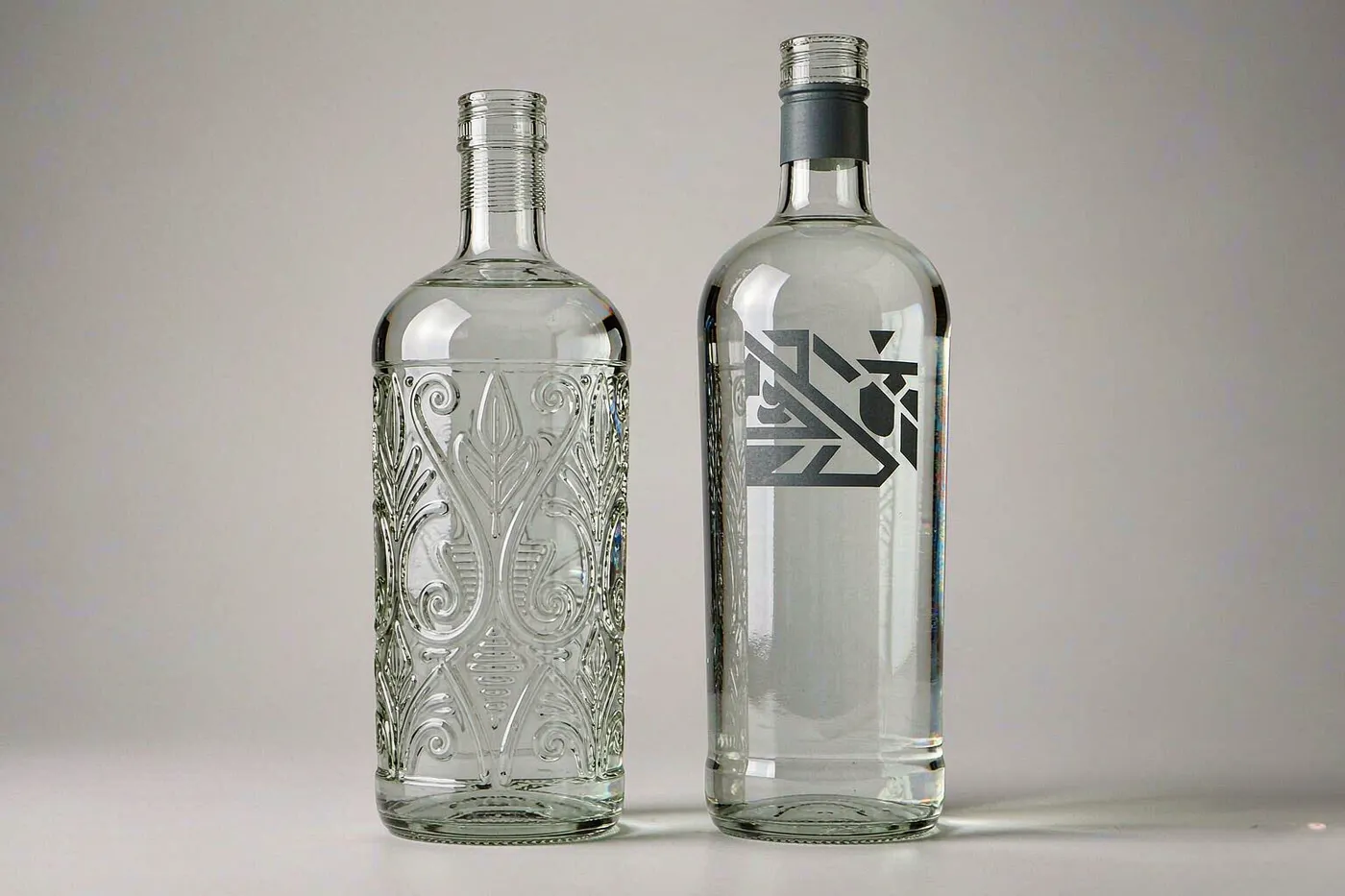
Embossing and printing solve different problems. Embossing puts the mark in the glass, permanent and free per unit after tooling. Printing puts colour and detail on the glass, cheap to start and expensive per unit. The break-even is a volume calculation.
Cost shape
- Embossing — one-off tooling charge, then effectively no per-unit decoration cost. Tooling is cut into the mould, so it only exists on custom tooling.
- Screen printing — low set-up per colour, then a per-unit cost for every pass.
- Decals — plate or print set-up, then a per-unit cost plus application labour.
- Spray coating — set-up plus per-unit cost, scaling with coverage and number of coats.
The crossover is where tooling divided by expected lifetime volume drops below the accumulated per-unit printing cost.
Durability
- Embossed detail — permanent, cannot rub off.
- Acid-etched surface — permanent, part of the glass surface.
- Fired ceramic decal — very durable.
- Screen print — durable when correctly cured, but can scratch.
- Spray coating — most vulnerable to transit scuffing.
Detail capability
- Embossing — bold shapes, crests, monograms, lettering. Not gradients, not fine lines.
- Screen printing — crisp type, spot colour, controlled registration.
- Decals — full colour including gradients and halftones.
Practical constraints
- Embossing adds tooling complexity and lead time, and must be locked before the mould is cut.
- Printing needs a flat, consistent panel; heavy taper or texture reduces print quality.
- Coating over embossing can soften the relief, so sequence matters.
- Decoration near the finish risks interfering with closure seating.
A decision rule
- Long-lived core SKU with stable volume: emboss the brand mark, print the rest.
- Launch or test SKU: print only, keep tooling cost at zero.
- Premium gifting: emboss plus frosting or a coating.
- Frequent artwork changes: print or decal, never emboss the changing part.
What each process can and cannot do
Embossing and debossing put relief into the glass itself, via the mould. They are excellent at:
- Logos and wordmarks with clean, bold shapes.
- Shoulder or base detail that survives handling.
- Tactile quality — the bottle feels different in the hand.
They are poor at fine detail, small text, gradients and multi-colour work, because the relief is limited by glass flow and draft angles.
Print — screen, ceramic or digital — sits on the surface. It handles fine detail, colour and gradients well, and can be changed without touching the mould. It is the weaker choice where abrasion and washing resistance matter most.
A useful shorthand: emboss for permanence and touch, print for detail and flexibility.
The hybrid most brands end up with
Most premium spirits bottles use both, because the processes solve different problems:
- Emboss the permanent brand mark — logo, name, or a signature shoulder detail. This is the element that should never change.
- Print the variable content — variant names, batch information, market-specific text, regulatory copy.
That split means a recipe or market change does not force a new mould, which is usually the deciding factor.
Cost behaviour at different volumes
- Embossing is a tooling cost with a low marginal cost. It suits stable, high-volume SKUs.
- Print is the reverse — little or no tooling, but a per-unit cost and a setup charge per design.
The crossover depends on volume and on how often the design changes. If the design is stable, embossing wins over time. If it changes per variant or per market, print wins at almost any volume.
A worked decision rule
Ask three questions in order:
- Will this element change within two years? If yes, print it.
- Does it need to survive heavy handling or washing? If yes, emboss it.
- Is it fine detail, small text or multi-colour? If yes, print it.
If the answers conflict, use both — emboss the permanent mark and print the variable layer.
Combining both on one bottle
Using embossing and print together is the norm rather than the exception, and the combination works because each process covers the other's weakness:
- Emboss the permanent brand element — the mark that must not change and must survive handling.
- Print the variable layer — variant names, batch codes, market text, regulatory copy.
Design the two so they do not fight. Printing over a raised area causes registration problems; printing immediately beside an embossed edge often looks misaligned even when it is not. Leave a clear zone between them.
What mould wear does to relief over time
An embossed detail is only as sharp as the mould cavity that forms it, and cavities wear.
- Fine relief softens first. Shallow embossing loses definition earlier than deep relief.
- Sharp corners round off, both in the mould and in the glass that flows into it.
- Wear is uneven across the mould set, so the same detail can look different between cavities.
If an embossed element is central to the brand, plan for cavity refurbishment or mould replacement as a recurring cost, and keep a first-article reference sample to compare against.
Draft angles and relief depth
Embossing has hard geometric limits that print does not:
- Draft angle — relief needs a draft for the glass to release from the cavity; without it, detail tears.
- Relief depth — deep relief reads better and lasts longer, but it also increases glass thickness locally and can affect wall distribution.
- Minimum feature size — fine lines that are trivial in print may not fill reliably in glass.
Ask the plant for its limits before the artwork is finalised. Designing to the process is faster than redesigning for it.
Cost at different run lengths
- Very short runs — print wins clearly, because there is no tooling to amortise.
- Mid volumes — the gap narrows, and the decision usually turns on how often the design changes.
- High volumes with a stable design — embossing wins on marginal cost, and the relief also improves durability.
- Multi-market ranges — print usually wins, because market-specific text cannot be embossed.
The crossover is rarely a precise number. It moves with design stability, which is why the question to ask is how often the artwork will change, not how many units you will buy.
Key takeaways
- Emboss for permanence and touch; print for detail and flexibility.
- Most premium bottles use both - emboss the permanent mark, print the variable layer.
- Embossing is constrained by draft angle, relief depth and minimum feature size.
- Tooling suits stable designs; print suits changing ones - the crossover is about design stability, not just volume.
- Mould cavities wear, so fine relief softens over time and needs a refurbishment budget.
- Leave a clear zone between embossed and printed elements to avoid registration problems.
Frequently Asked Questions
Is embossing cheaper than printing?
Depends on volume. Embossing has a one-off tooling cost but near zero per-unit cost, so it wins at high volume. Printing has low set-up but a per-unit cost, so it wins at low volume.
Which lasts longer?
Embossing and acid etching, because they are formed in the glass rather than sitting on it, so they do not wear off with handling or washing. Coatings and inks are surface layers and can scuff, particularly at the base and shoulder where bottles contact each other on a line.
Can I get fine detail with embossing?
Only to a limit. Embossing suits bold marks, crests, lettering and simple geometric patterns, because the glass has to flow into the mould detail. Fine gradients, small type and photographic imagery need printing, decals or a label, so the two processes usually work together rather than compete.
Does embossing affect bottle strength?
It can. Deep embossing changes wall thickness distribution and can create stress concentration, so it needs to be reviewed against vertical load and thermal shock requirements. Shallow, well-radiused detail is much safer than sharp, deep lettering, particularly on a lightweighted bottle.
Can I combine processes?
Yes, and most premium bottles do. A common combination is an embossed brand mark, a sprayed body colour and screen-printed text, sometimes finished with a frosted panel. Each additional process adds a set-up and a quality check, so the combination should be justified by shelf impact.
Related
- Custom Glass Bottle Decoration: Embossing, Etching, Coating and Printing
- Private Label Spirits Bottles: What You Can Customise at Low MOQ
- Standard vs Custom Mould: Cost, Lead Time and Break-even for Spirits Bottles
Written by Eric Jiang, Glass Packaging Engineer, 12 years.