Lightweighting Spirits Bottles Without Breaking Them
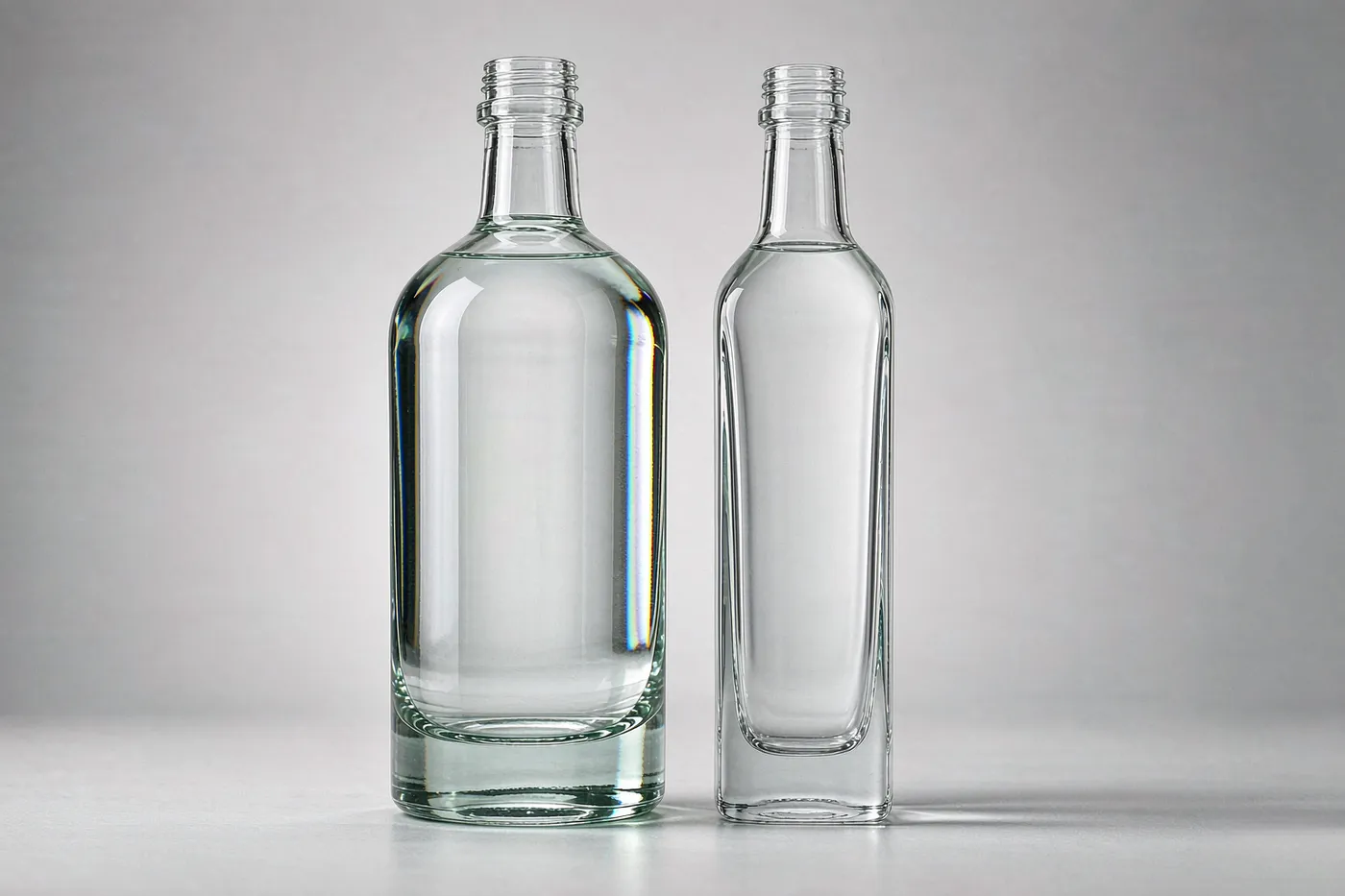
Lightweighting removes glass from a bottle while keeping it strong enough to survive filling, capping and distribution. Done properly it cuts material cost and emissions; done carelessly it produces a line full of cracked bottles.
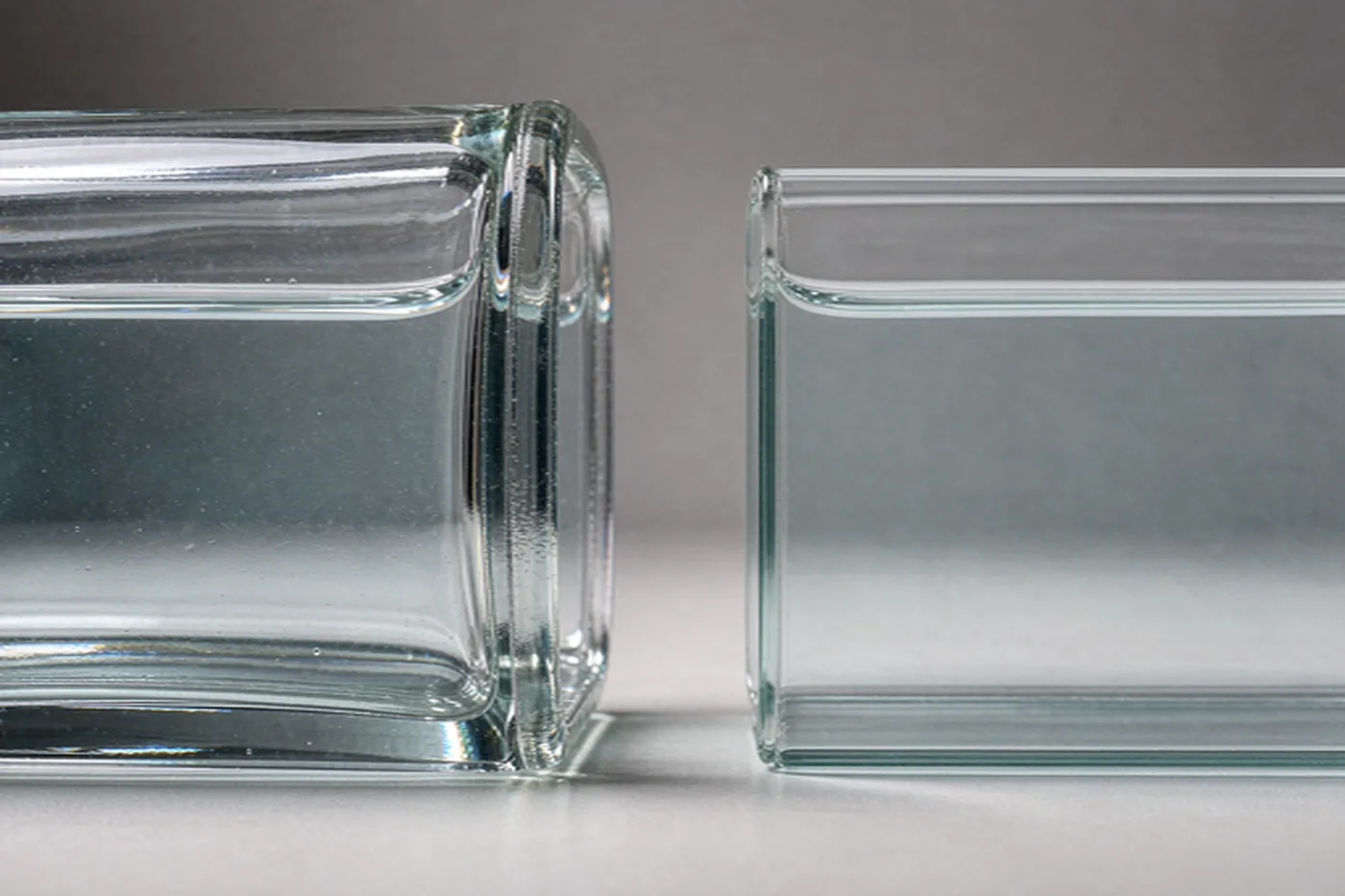
Why it is worth doing
- Material cost — glass is priced by mass, so every gram removed saves money.
- Freight — less weight per pallet.
- Emissions — less material to melt and less mass to move.
Published life-cycle work on container glass supports all three, with the size of the benefit depending on cullet ratio, furnace efficiency and transport distance.
What limits how far you can go
- Vertical load — capping heads press down on the finish.
- Internal pressure — relevant for carbonated or pressurised formats.
- Thermal shock — hot-fill, pasteurisation or large transit temperature swings.
- Impact — handling, carton stacking and pallet shifting.
The tests that matter
- ASTM C147 — internal pressure test for glass containers.
- ASTM C149 — thermal shock test, commonly specified as surviving a sudden 42 degrees C drop.
- Vertical load or top-load strength — confirmed against the capping head's rating.
- Transit testing — packed cartons on the real route.
Design moves that help
- Smooth the shoulder and base transitions, because sharp geometry concentrates stress.
- Keep mass low in the base where it helps stability rather than in the wall.
- Use protective coatings on the outside surface to reduce abrasion damage.
- Flatten the contact surface where bottles touch in the carton.
The branding tension
Heavier glass reads as more premium, so lightweighting has a ceiling set by the price tier. The practical approach is to set the heaviest weight the tier and the distribution chain can carry, then remove glass everywhere else.
How to brief it
- State the target weight and the acceptable tolerance.
- State the filling method and line speed.
- State the distribution chain, including export handling.
- Require the test reports before bulk release.
Where the weight actually sits
On a spirits bottle the glass is distributed roughly as follows:
- Base and heel — the thickest region, and where the most weight can usually be removed.
- Body walls — constrained by top-load and internal pressure requirements.
- Shoulder and neck — the least reducible, because the finish geometry is fixed by the closure.
In practice most lightweighting programmes take weight out of the base first, then the body, and leave the finish alone.
Note that heavy bases are often there for perceived quality rather than function. That is a branding decision, and it should be made explicitly rather than inherited.
The failure modes to test for
Reducing glass mass has three predictable consequences, each with a standard test:
- Top-load failure — the bottle cracks under the capping head. Tested as vertical load strength.
- Internal pressure failure — relevant for carbonated or pressure-filled products. Tested as internal pressure resistance.
- Thermal shock failure — breakage on hot-fill or rapid temperature change. Tested as thermal shock resistance.
Test all three on samples from production steel after lightweighting. Do not rely on simulation alone for the final release.
Design moves that remove weight without losing presence
- Reduce base thickness and add a punt — removes glass while keeping the footprint stable.
- Move weight visually with decoration — a heavier-looking base can be achieved with frosting and print rather than with glass.
- Tighten the shoulder radius — a sharper shoulder often reads as more premium and uses less glass.
- Keep the finish heavy-looking — the neck is where buyers look, and it is the cheapest place to spend a little glass.
The pattern is to spend glass where it is seen and remove it where it is not.
How to brief a lightweighting programme
Give the plant four things:
- Current weight and the target weight — a number, not a direction.
- The filling line parameters — method, line speed and capping head type.
- The tests you will accept the bottle against — top load, internal pressure, thermal shock.
- The branding constraints — what the bottle must still look like on shelf.
A brief with these four elements can be quoted accurately. One without them generates a guess.
Lightweighting an existing bottle
Retrofitting weight out of a running bottle is different from designing light from the start:
- Establish the current margin — where the bottle currently passes, and by how much.
- Remove weight from the least visible region first, usually the base and lower body.
- Change one variable at a time, because two simultaneous changes make a failure unattributable.
- Re-validate on production samples before releasing the change.
Most programmes can remove a meaningful share of glass from a bottle designed some years ago, because design margins have tightened as forming and inspection have improved.
Verifying the result
- Weigh a statistically meaningful sample, not a handful, and record the distribution.
- Re-run the strength tests that defined the original specification.
- Check the line before committing volume — a lighter bottle can behave differently at speed.
- Confirm packing performance, since a lighter pack can shift differently in transit.
Record the before and after weights with dates. It is the evidence base for both the cost saving and the quality claim.
Common reasons programmes stall
- The lightweighted bottle fails top load, and the mould has to be reworked.
- The line behaves differently at speed, particularly on the capping head.
- Scuffing increases as wall thickness drops and handling damage becomes more visible.
- The brand team rejects the result, because weight was doing branding work nobody had articulated.
Each is avoidable by setting the acceptance criteria — strength, line performance, appearance — before the mould is modified rather than after.
Effects beyond freight
Weight reduction reaches further than the freight invoice:
- Carbon reporting — glass mass is a direct input to most packaging footprint calculations.
- Handling and ergonomics — lighter cases are easier to move, which matters in on-trade and warehouse environments.
- Breakage profile — a different wall distribution changes how the bottle fails under impact.
- Perceived value — the one effect that can work against you, and the reason the branding question has to be answered first.
Model all of them before committing to a target weight. The freight saving alone is usually the smallest of the four.
Key takeaways
- Most removable weight sits in the base and heel; shoulder and neck are constrained by the finish.
- Heavy bases are usually a branding decision rather than a functional requirement.
- Test top load, internal pressure and thermal shock after any weight change.
- Change one variable at a time, so a failure can be attributed.
- Programmes stall on top load, line behaviour, scuffing, or brand rejection - set acceptance criteria first.
- Effects reach beyond freight: carbon reporting, handling, breakage profile and perceived value.
Frequently Asked Questions
How much weight can be removed safely?
It depends on the shape, the distribution of glass and how the line handles the bottle. Plants validate a target through strength and transit testing rather than applying a universal percentage, so the answer for a given design comes from test results, not from an industry average.
Does lightweighting increase breakage?
It can, if wall distribution is thinned without validation, because the areas that lose material are often the ones carrying top load. With proper testing of vertical load, internal pressure, thermal shock and transit, a lighter bottle can perform to the same standard as the heavier design it replaces.
Does lightweight glass look cheaper?
Not necessarily. Perceived value tracks overall mass and base design more than wall thickness, so a well-designed lightweight bottle with a solid base and a considered shoulder can still read as premium. What reads as cheap is thin glass at the base and a bottle that flexes in the hand.
What tests validate a lightweight bottle?
Vertical load or top-load strength, internal pressure resistance where relevant, thermal shock resistance, impact testing and a transit test on packed cartons. The transit test matters most, because a bottle that passes in the laboratory and fails in a container has not been validated.
Does lightweighting actually reduce emissions?
Yes, through less material melted and less mass transported. Published life-cycle work on container glass shows the effect is real, though the size depends on cullet ratio, furnace efficiency and transport distance.
Will a lighter bottle survive capping?
It has to be checked, because capping heads apply significant top load and lightweighting removes exactly the material that resists it. This is the most common failure point in lightweighting programmes, so the capping specification should be part of the design brief rather than an afterthought.
Related
- Glass vs Aluminium vs Plastic Bottles for Spirits: A Buyer's Comparison
- Export Packaging and Shipping for Glass Liquor Bottles
- EU and UK Spirits Packaging Trends: Sizes and Sustainability
Written by Eric Jiang, Glass Packaging Engineer, 12 years.