Liquor Bottle Sizes and Capacity Guide: 50ml to 2000ml Compared
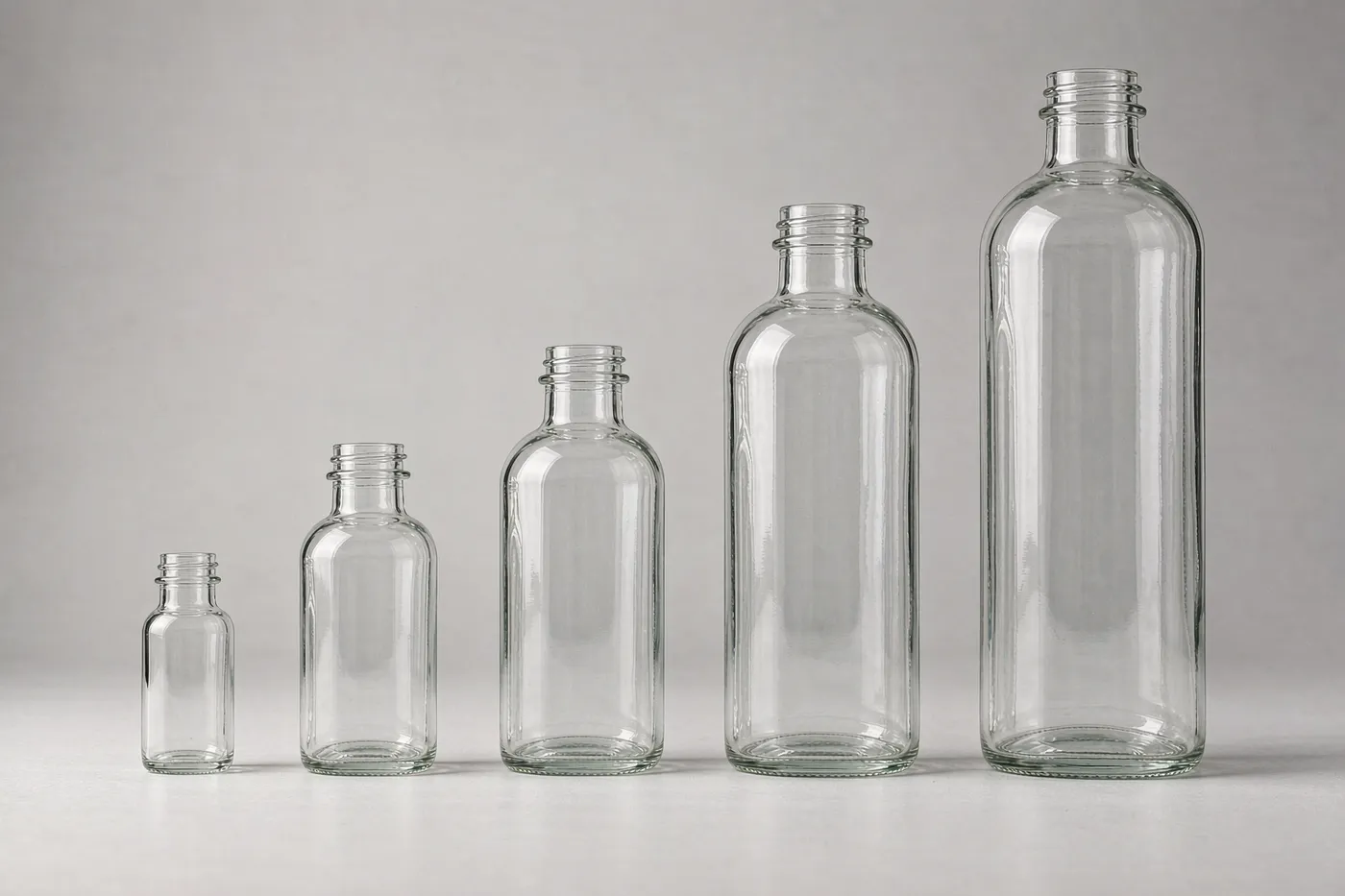
Spirits bottles are not freely sized. The United States authorises a fixed list of metric standards of fill under 27 CFR 5.203, and the EU does the same through Directive 2007/45/EC. You pick the volume from that list first, then tune for price tier, shelf presence and freight cost.
The sizes that actually sell
- 50ml — 1.7 fl oz. Miniatures, airline and hotel minibars, sample programmes, gift packs.
- 100ml — 3.4 fl oz. Sampling, airline, selected duty-free formats.
- 200ml — 6.8 fl oz. Half-pint equivalent; entry price point and gift sets.
- 350ml — 11.8 fl oz. Permitted for spirits in the EU; a lighter entry size.
- 375ml — 12.7 fl oz. Half bottle; common for liqueurs and premium small formats.
- 500ml — 16.9 fl oz. EU-authorised; popular for liqueurs and cream spirits.
- 700ml — 23.7 fl oz. The EU and UK standard for spirits.
- 750ml — 25.4 fl oz. The US standard and the global wine bottle size.
- 1L — 33.8 fl oz. Duty free, travel retail, and the standard full bottle in much of continental Europe.
- 1.75L — 59.2 fl oz. US "handle"; high-volume retail and on-trade.
Note that 750 ml is the global wine standard but is not on the EU spirit-drinks list. If you sell into both markets, plan 700 ml for the EU and 750 ml for the US.
US authorised standards of fill
Under 27 CFR 5.203(a)(1), the authorised metric standards of fill for distilled spirits in containers other than cans are 1.8 L, 1.75 L, 1.00 L, 900 mL, 750 mL, 720 mL, 700 mL, 375 mL, 200 mL, 100 mL and 50 mL. Metal cans have a separate list under 27 CFR 5.203(a)(2).
Three practical consequences:
- Fill tolerance. TTB's published gauging manual (SSD:TM:516, Rev. 6, issued 26 March 2025, implemented 9 April 2025) sets tolerance by fill band: plus or minus 1.5% at 1 L and above; plus or minus 2.0% for 376-999 mL; plus or minus 3.0% for 101-375 mL; plus or minus 4.5% at 100 mL and below.
- Headspace. For containers of 200 mL or more, headspace must be no more than 8 percent of total bottle capacity, per 27 CFR 5.202(b).
- Temperature. Proof is defined at 60 degrees F under 26 U.S.C. 5002(a)(10), so fill is determined at that temperature.
A bottle sold as 700 ml therefore has a brimful capacity noticeably above 700 ml, and the filler controls the actual fill against a calibrated flask.
EU nominal quantities
Directive 2007/45/EC lays down nominal quantities for prepacked products. For spirit drinks the permitted interval runs from 100 ml to 2000 ml, and only these nine nominal quantities are allowed: 100, 200, 350, 500, 700, 1000, 1500, 1750 and 2000 ml.
The practical difference from the US list matters at the specification stage. 500 ml and 350 ml are EU-authorised; 720 ml, 900 ml and 1.8 L are US-authorised. A single global bottle cannot satisfy both lists cleanly, which is why most exporters run 700 ml and 750 ml as separate SKUs.
Fill tolerance and your specification
Fill tolerance is not the same as bottle capacity tolerance. The bottle has to physically hold the nominal fill plus headspace, and the glass plant controls that through a brimful capacity specification. When you brief a new mould, specify:
- Nominal fill and target headspace.
- Brimful capacity and its tolerance.
- Filling method, because vacuum, gravity and overflow fillers behave differently against the same headspace target.
- Closure type, since the closure displaces part of the neck volume.
How size drives weight, freight and breakage
Volume is the single biggest driver of landed cost, acting through three channels:
- Glass mass — a 1.75 L bottle uses roughly twice the glass of a 750 ml bottle at equal wall thickness.
- Pallet density — small bottles pack more units per pallet, so freight per unit falls, while cartoning and handling cost per unit rises.
- Breakage risk — larger formats carry more surface area and higher impact energy in transit.
That is why lightweighting pays back much faster on large formats than on miniatures.
Choosing the right size
- US-bound: lead with 750 ml, add 50 ml for sampling, and only tool a 1.75 L if you have genuine high-volume retail distribution.
- EU or UK-bound: lead with 700 ml, with 1 L for travel retail.
- Gifting and discovery: 200 ml and 350 ml lower the trial price without diluting the brand.
- On-trade sampling: 50 ml is the standard unit.
Miniature and sample formats
Below 200 ml the economics invert. Filling, capping, cartoning and handling costs are largely per unit rather than per volume, so a 50 ml bottle can cost more per millilitre of contents than a 750 ml bottle. That is accepted, because the format is bought for sampling, airline and hotel minibars, and gift packs rather than for value.
Two practical notes:
- 50 ml is the sampling standard. It is on the US authorised list and is accepted in most markets without special justification.
- 100 ml is the airline default. It sits under most cabin liquid rules and is the common duty-free miniature size.
Miniatures also carry a higher breakage rate per unit in transit, because the cartons are light and tend to be packed loose. Specify dividers.
Duty free and travel retail
1 L is the core travel retail size, and it is also the standard full bottle across much of continental Europe. If you plan a travel retail listing, 1 L is usually the format to tool first, with 700 ml or 750 ml following for domestic distribution.
Note the labelling difference: travel retail often requires additional market-specific labelling that domestic product does not, so confirm requirements before you print.
Pallet and container planning
Volume drives landed cost through pallet density. The pattern to expect:
- Small formats (50 to 200 ml) — many units per carton, high cartons per pallet, so air and void space dominate. Freight per unit is low; handling per unit is high.
- Mid formats (350 to 750 ml) — the efficient middle. Standard pallet patterns apply and breakage is manageable.
- Large formats (1 L to 1.75 L) — fewer units per pallet and more glass mass, so freight per unit rises sharply and lightweighting pays back fastest.
Ask your supplier for the pallet pattern and units per container, not just the unit price. Two quotations with the same unit price can differ materially in landed cost once pallet density is taken into account.
Regional size conventions at a glance
- United States — 750 ml is the retail standard, with 1.75 L for high-volume and 50 ml for sampling.
- European Union and United Kingdom — 700 ml is the standard, with 1 L for travel retail.
- Duty free and travel retail — 1 L dominates.
- Asia-Pacific — 700 ml is common, with smaller formats well established.
The practical rule: 700 ml and 750 ml are separate SKUs, not interchangeable. Plan for both if you sell into both markets.
Sizing for sampling programmes
- 50 ml is the standard sample unit and is widely accepted without justification.
- 200 ml works where the sample needs to feel like a product rather than a taste.
- Gift sets combine several small formats to raise perceived value without a large volume commitment.
Because per-unit costs dominate at small sizes, the decision is usually about presentation rather than unit economics.
Key takeaways
- Spirits sizes are regulated, not freely chosen: the US list under 27 CFR 5.203 and the EU list under Directive 2007/45/EC do not match.
- 700 ml is the EU and UK standard; 750 ml is the US standard; 1 L dominates duty free and travel retail.
- Brimful capacity, not nominal fill, is what the drawing controls.
- Fill tolerance and bottle capacity tolerance are separate specifications.
- Volume drives landed cost through glass mass, pallet density and breakage together.
- Below 200 ml the economics invert, because most costs are per unit rather than per volume.
Frequently Asked Questions
What is the standard liquor bottle size in the US?
750ml is the dominant US retail size. It is one of the metric standards of fill authorised by TTB under 27 CFR 5.203(a)(1), alongside 50ml, 100ml, 200ml, 375ml, 700ml, 720ml, 900ml, 1L, 1.75L and 1.8L.
Why are European spirits bottles 700ml?
700 ml is one of the nine nominal quantities permitted for spirit drinks in the EU under Directive 2007/45/EC, which also lists 100, 200, 350, 500, 1000, 1500, 1750 and 2000 ml. The list replaced older national sizes and made a single 700 ml bottle workable across member states.
Can I sell a 650ml spirits bottle in the US or EU?
No. Both markets restrict prepacked spirits to a fixed list of authorised sizes, so a 650 ml bottle would be non-compliant in either. The US list and the EU list overlap but are not identical, which is why some brands run separate moulds for each market.
How much does an empty 750ml glass bottle weigh?
Typical empty weights run from roughly 400g for a lightweight flint bottle to more than 900g for a heavy-base premium bottle. The exact figure comes from the specific mould drawing rather than a category average.
What is the difference between 750ml and 1L for export?
750ml is the US retail standard and the global wine size. 1L is the standard full bottle in much of continental Europe and the core size for duty free and travel retail.
Does bottle colour affect recycling?
Yes. Glass is recycled by colour, so mixed-colour cullet lowers the value of the batch and limits what it can be remelted into. Flint and amber are the most widely accepted streams, green is well established, and unusual colours such as cobalt blue are harder to place.
Why do miniature bottles cost more per millilitre?
Because most of the cost is per unit, not per millilitre. Filling, capping, labelling, cartoning and quality checks each take roughly the same line time whether the bottle holds 50 ml or 700 ml, so the same labour is spread across far less liquid. Lower glass weight per unit does not offset that.
Related
- Liquor Glass Bottle Buyer's Guide 2026: Capacity, Glass Type, MOQ and Cost
- Miniature and Sample Bottles: 50ml, 100ml and 200ml Formats
- How to Read a Glass Liquor Bottle Spec Sheet (With a Worked Example)
Written by Eric Jiang, Glass Packaging Engineer, 12 years.